PIMS-UManitoba Distinguished Colloquium: Dave Campbell
Topic
Recent Advances in Modelling Text as a Dependent Variable
Speakers
Details
Latent Dirichlet Allocation and Text embeddings have revolutionized the use of text as data leading to vastly improved document clustering and retrieval and recommender systems by finding lower dimensional structure in the text. Furthermore, these computational advances have seen substantial success when modelling text as an independent variable to be associated with numerical or categorical dependent variables. However these tools bring forward substantial challenges when considering inferential questions related to text in that these tools are highly dependent on random seed initialization. This talk focuses on the scenario where lower dimensional structure of the text is of inferential interest, with particular consideration to how to model the evolution of text structure in association with changes in covariates. We consider deterministic transformations of the text into data and model sampling variability directly as part of the regression models. We consider applications to product reviews and economic speeches from Central Banks.
Additional Information
Biography:
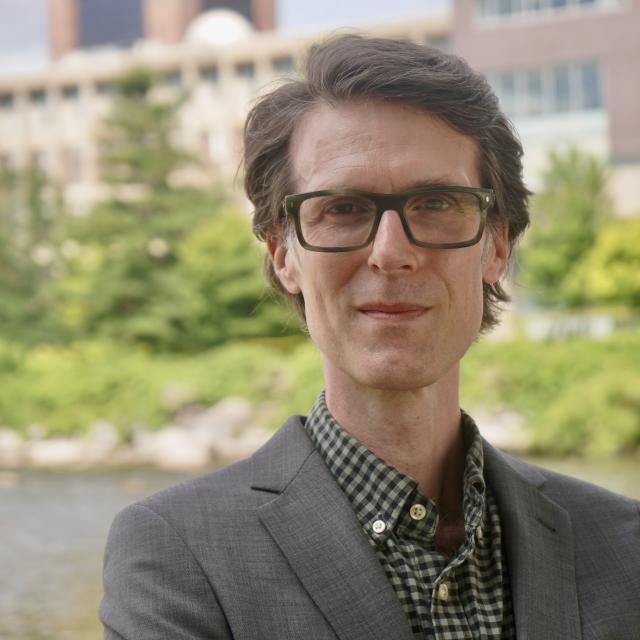
Dr. Dave Campbell is a Professor in the School of Mathematics and Statistics and the School of Computer Science at Carleton University. Academically, he runs a collaborative team researching inferential algorithms at the intersections of statistics with machine learning, computing, natural language processing, and applied mathematics to solve problems inspired by industry and government collaborations.
His career path maintains a theme of Industrial collaborations including spending 2021-2023 on leave from academia to lead the inferential Data Science team at the Bank of Canada. At the Central Bank, he oversaw projects relating to cybersecurity, forecasting banknote demand, understanding drivers of inflation, and ensuring data privacy. Before moving to Carleton University in 2019, he was a faculty member at Simon Fraser University, where he led the creation one of Canada’s first Bachelors of Data Science degrees. He was the inaugural President of the Data Science and Analytics Section of the Statistical Society of Canada and is currently President of the Business and Industrial Statistics Section.