




Spotlight on the latest Maths & Oceans article from Paul Vigneaux, on residence at PIMS from France.
Call for new courses
PIMS Network Wide Courses
The PIMS Network Wide Courses programs helps share graduate level courses throughout the PIMS network. Registration for winter courses is now open. Application deadlines vary but begin in November.
Event
Emergent Research Seminar
Discover cutting-edge research by PIMS Postdoctoral Fellows—sign up now to attend our Emergent Research seminars.
Opportunity
PIMS/BIRS Team Up! Pathways to Inclusive Research
PIMS offers collaborative opportunities for those who have faced barriers such as family obligations, isolation or limited funding. Apply today!
Newsletter
PIMS Connection
Stay connected to mathematical research, programs, and events across Canada and the international PIMS network.
News Article
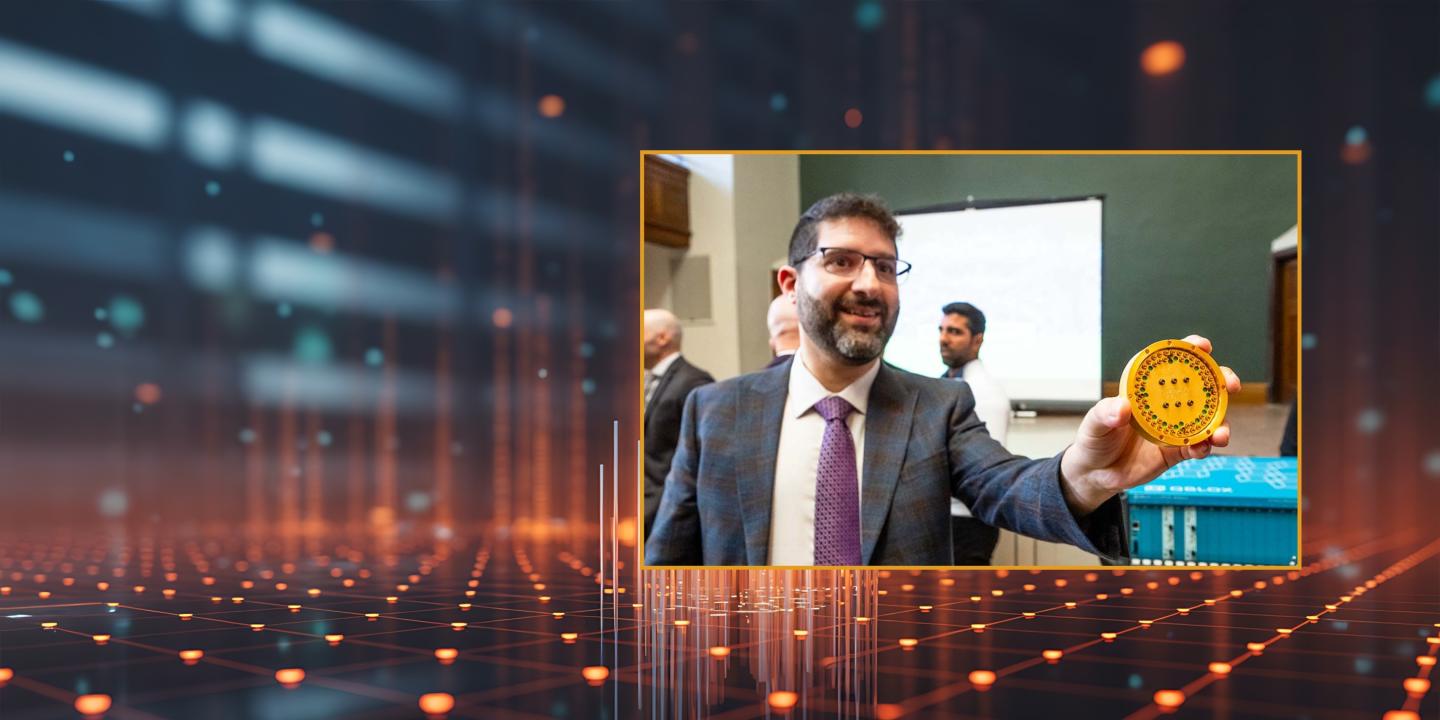
PIMS-Supported Research Leads to Major Quantum Computing Initiative
Led by Dr. Steven Rayan, this initiative advances Canada’s growing leadership in quantum science.
Funding Available
PIMS-BIRS-Simons Travel Award
PIMS-BIRS-Simons Travel Award helps provides funding for researchers attending a BIRS 5-day (or longer) program to maximize the impact of their travel by visiting a PIMS site for collaboration.
Call for Nominations
PIMS Network Wide Colloquium
PIMS 2025-2026 Network Wide Colloquium begins on Thursday September 25th with our first speaker, Fields Medalist Curtis McMullen. Four other speakers will round out this high profile network wide event.
The PIMS mandate is to promote excellent research and applications of the mathematical sciences, to facilitate the training of highly qualified personnel, to create an equitable, diverse and inclusive community in the mathematical sciences, to enrich public awareness of and education in mathematics and to create partnerships with similar organizations around the world.
Graph toughness, introduced by Chvátal in 1973, is a key measure of how well different parts of a graph are connected, with implications for Hamiltonicity, spanning trees, connectivity, and more. We derive new bounds on graph toughness and confirm...
Let F be a homogeneous polynomial of degree n in at least d 2 + 1 variables over the p-adic numbers, Q p . Artin conjectured that such F always have nontrivial zeros in any p -adic field. Although this has been shown to be false in general, the...
A fundamental problem in artificial intelligence is how to simultaneously deploy data from different sources, such as audio, images, text, and video, collectively known as multimodal data. In this talk, I will present a mathematical framework for...
For a standard-graded polynomial ring R, the d-Veronese subring is generated as a k-algebra by degree d monomials, is Koszul, and its defining ideal is quadratic, binomial, and determinantal. In this talk, I will discuss what happens if we instead...
I will tell the story of a mathematical problem which can be understood and tested by a child, yet which has resisted solution for over a century, in spite of the efforts of many prominent mathematicians. I will describe in parallel the development...
One of my favorite quotations in mathematics is due to Titchmarsh, who remarked: “The finer theory of the partial sums of the Möbius function is extremely obscure, and the results are not nearly so precise as the corresponding ones in the prime...
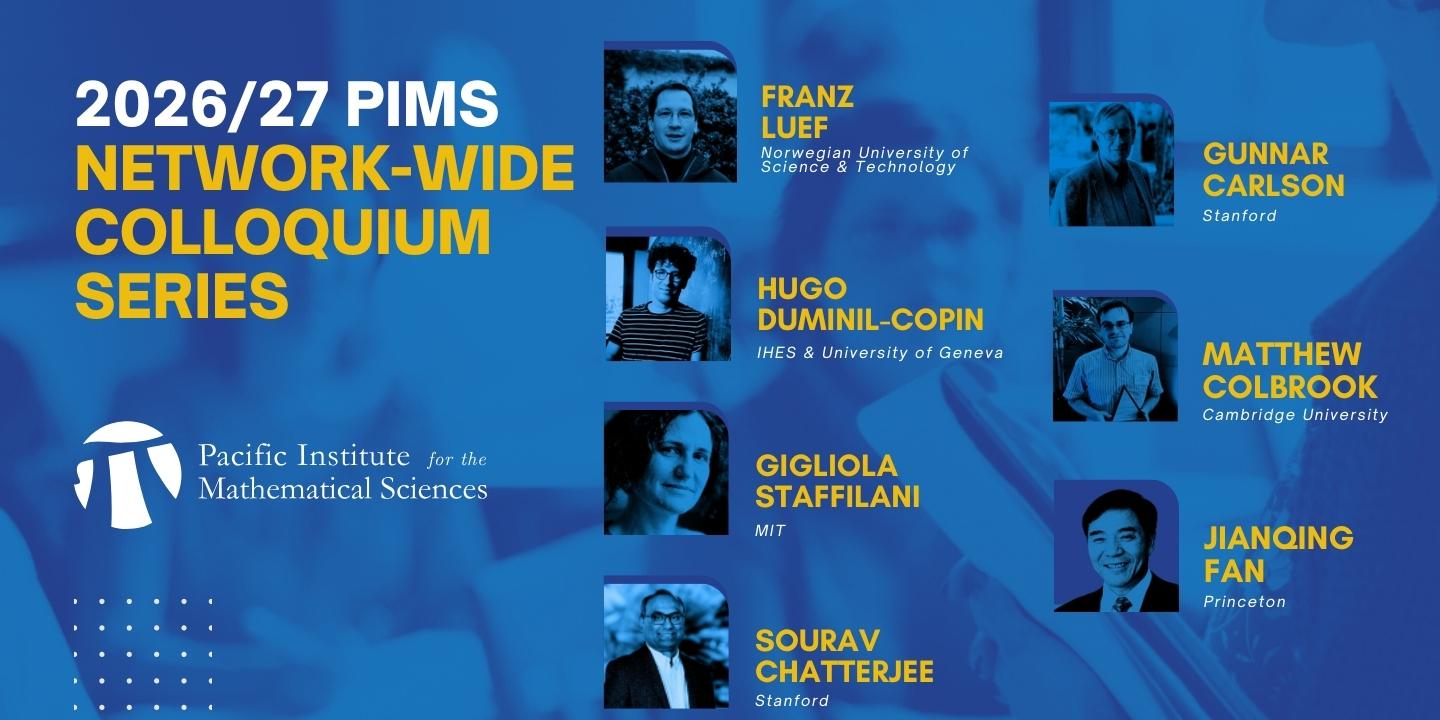
The Pacific Institute for the Mathematical Sciences (PIMS) invites nominations for its 2026–2027 Network-Wide Colloquium Series. This flagship lecture series showcases leading voices in contemporary...
A major milestone in Canadian research and innovation is underway at the University of Saskatchewan, where a new quantum computer will position the institution as a national hub for quantum science...
On March 14—Pi Day—the Pacific Institute for the Mathematical Sciences (PIMS) begins celebrating 30 years of advancing the mathematical sciences. For three decades, PIMS has supported research...