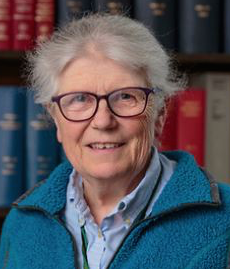
Elizabeth A. Thompson
Elizabeth A. Thompson is a professor emerita in the Department of Statistics, University of Washington. Until her retirement in 2018 she was professor of Statistics and also adjunct professor in the departments of Biostatistics and of Genome Sciences at the University of Washington, and the Director of the University of Washington Interdisciplinary Faculty Group in Statistical Genetics (1999-2017).She remains Director of an Interdisciplinary Graduate Certificate program in Statistical Genetics. She received her B.A. (1970) in mathematics and Ph.D. (1974) in mathematical statistics from Cambridge University, UK and then did postdoctoral work in the Department of Genetics, Stanford University, before taking up a position on the faculty of the Department of Pure Mathematics and Mathematical Statistics, University of Cambridge in 1976. She served as a University Teaching Officer on the faculty from 1976 to 1985, while she also was a Fellow of Kings College Cambridge from 1975-81, and then Fellow and Director of Studies in Mathematics at Newnham College. She joined the faculty of the University of Washington in December 1985, as a professor of statistics, where she served as Chair 1989-1994, and again 2011-2014.
Dr. Thompson's research interest is in the development of methods for mode-based likelihood inference from genetic data, and particularly from data observed on large and complex pedigree structures. Questions of interest range from analyses of long-term gene frequency differentiation in widely dispersed populations, to short-term extinction of genes in the small population of a highly endangered species; from inference of genealogical relationships among individuals to inference of the genetic basis of traits from data observed on members of a known pedigree; and from analyses of patterns of genome sharing in plants to modern methods for human linkage analysis. In recent years, several of these questions have been addressed using Monte Carlo likelihood. She has held NSF grants in Population Biology (1987-90), Conservation Biology (1990-93) and Computational Biology (1993-97 and 1998-2002). Also in interdisciplinary development, she was a member of the Program in Mathematics and Molecular Biology (1994-2006), funded as a Burroughs Welcome Interfaces in Science program with the mission to recruit and train students from the mathematical sciences in cross-disciplinary work in mathematical molecular biology. At the University of Washington, she participated in interdisciplinary graduate programs in Quantitative Ecology & Resource Management, in Computational Molecular Biology, and in the Mathematical Biology Fellows program. However, her core research has been through an NIH award in the Genetic Epidemiology of Complex Traits. Initially funded in 1991, this award has been an R37 MERIT award since 2008, and ends only now in 2020.
Dr Thompson has served on the Scientific Advisory Boards of the Pacific Institute for Mathematical Sciences, the Banff International Research Station, and the Institute for Pure and Applied Mathematics and on the Board of Trustees of the National Institute for Statistical Science., and as a member of Council of the International Statistical Institute. She has also served on the National Research Council Committee on Applied and Theoretical Statistics, on the Committee to Review the Scientific Approaches used during the FBI's investigation of the 2001 Anthrax letters, and is a current member of the Board of Mathematical Sciences and Analytics. Her primary academic society affiliation has been to the International Biometric Society (IBS), first serving as a member of the British Region Committee in 1984-5. From 1997-1999, she served on the Executive Committee of West North American Region(WNAR) and was WNAR President in 1998. She was a member of the Council of the IBS, 2006-2013, and President 2016-2017.
Dr. Thompson is a recipient of a Doctor of Science degree from the University of Cambridge, the inaugural Jerome Sacks award for cross-disciplinary research from the National Institute for Statistical Science, the Weldon Prize for contributions to Biometric Science from Oxford University, UK, and of a Guggenheim fellowship. She is an honorary fellow of Newnham College, Cambridge, and an elected member of the International Statistical Institute, the American Academy of Arts and Sciences, and the US National Academy of Sciences.
She has been a member of the PIMS Board of Directors since 2020.